What is organizational culture?
The organizational culture was first introduced by Dr. Elliott Jaquesin his book “The Changing Culture of a Factory” published in 1951 (Hatch, 2013). Organizational culture refers to the long-standing beliefs and values of the organization (Tsai, 2011). In layman’s terms, every employee understands what is beneficial for the company, consciously forms and abides by the code of conduct. This blog will use the Laloux Culture Model to discuss the Agile Management Culture of Volvo Company in Sweden, provide suggestions to help Volvo implement its organizational culture adjustment.
Laloux cultural model
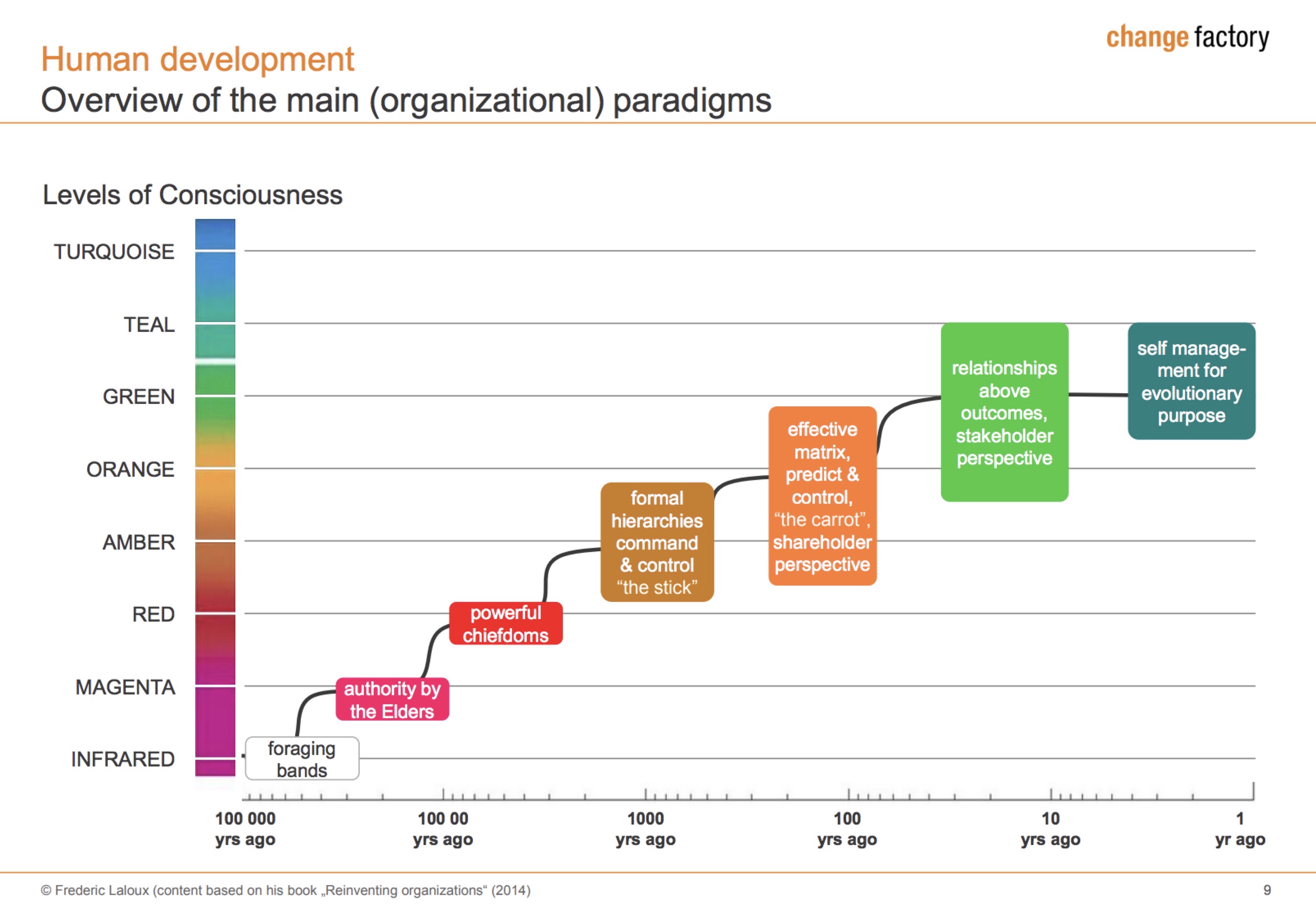
Frederic Laloux (2014) outlines how humans have been organized for centuries.
Around 10,000 years ago, humanity started organizing itself in chiefdoms and proto-empires. The first real organizations emerged in the form of small conquests of the army. These organizations labeled “Red,” are crude.
Starting around 4000 BC in Mesopotamia, humanity entered the Amber era of agriculture, state bureaucracies and organized religion, and people learned to exercise self-discipline and self-control (Laloux, 2015).
From the Renaissance to the present, the most popular point of view can be arguably the predominant perspective of most leaders in business and politics, which is marked as “orange” by Laloux (2015). It is a complex mechanism that can be understood and utilized through scientific and empirical investigations. Based on these, the Laloux culture model describes Volvo in a near-perspective way.
(Laloux, 2014)
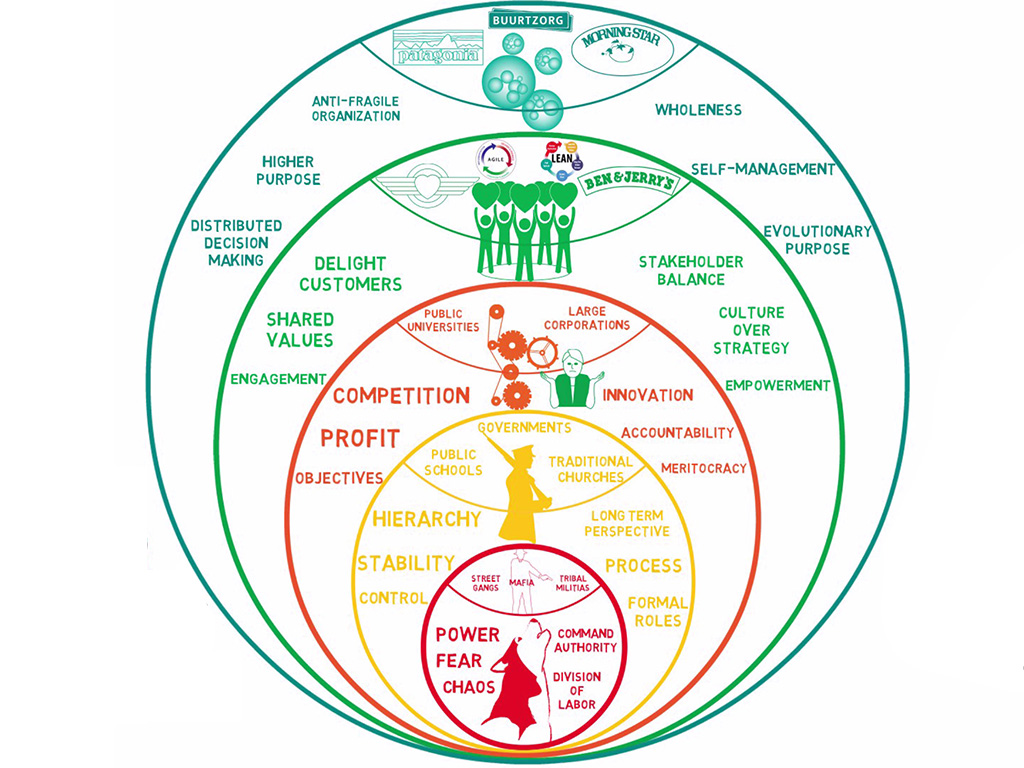
Laloux cultural model helps Volvo to observe and react to cultural change. It provides the location (orange) of the enterprise and the possible future (green or blue) of the enterprise, which helps to identify the benefits of change. In this chart, the Orange organization’s goal is to get ahead, to succeed in a socially acceptable way. “Green” stresses cooperation rather than competition and strives for equality, solidarity, and tolerance. And“blue” has established structures and practices that people have a high degree of autonomy in their field and is responsible for coordinating with others. Power and control are deeply embedded throughout the organization and no longer tied to the specific positions of a few top leaders.
Agile Management and Volvo Challenges
The primary challenge for Volvo is the transformation from the traditional industry into a new technology industry, which introduces an agile management culture (Ebrahimpur, 2001). They want to use of self-managed teams to accelerate the creation of new products and processes. And to realize the breakthrough in the three management of innovation, accountability and elite management in the orange phase mentioned by Laloux (2015).
However, in a face-to-face conversation, Volvo employees say that the process of one of their departments was like this: the senior manager assigned the plan with the shortened time limit to the intermediate supervisor. Then release the order. The people in each link did not understand very well the work of the previous link. As a result, the actual front-line employees have no way to understand the instructions of senior leaders fully, and the time for the middle leaders to find problems is not enough. In the end, the top leaders of their department were very dissatisfied with the crazy overtime work results of in the fourth quarter of last year, the managers and employees of the entire product line blamed each other and the team spirit deteriorated.
Implementing Organizational Culture Adjustment
(Laloux,2014)
The orange perspective recognizes the value of each aspect and the role of agile leaders. It helps Volvo to become better at the innovation and competitive advantage that it is most concerned. Agile way of thinking and practice will help achieve corporate values and impressive results, making employees more attractive and fulfilling.
Volvo needs a comprehensive assessment of the organization(Volvocars,2016). Identify key aspects of agile awareness, knowledge, support and opposition, and practical skills, and then develop strategies to bring about a cultural change. This means having to change the mindset, combine agility and mobility in business operations.
The first step is to develop leadership behavior, because the agility of the supervisor determines whether the organization continues to implement agility. According to Wouter Aghina (2015), promoting agility must be successful from top to bottom.
Secondly, improve the effectiveness of the most basic communication. Daniel Newman (2016) says that agile requires the connection. When a high-level manager issues an order, it needs to be efficient to let the most basic employees understand the order correctly.
Finally, Volvo should give employees full autonomy and build a team of mutual trust. Take employees as wealth, strengthen communication and enhance team building (Aghina,2015).
References
Aghina, W (2015) Agility: It rhymes with stability. McKinsey [Online]. Available at: https://www.mckinsey.com/business-functions/organization/our-insights/agility-it-rhymes-with-stability [Accsessed 5 Mar. 2019]
Ebrahimpur, G (2001) Restructuring for agility at Volvo Car Technical Service (VCTS). EUROPEAN JOURNAL OF INNOVATION MANAGEMENT; VOLUME 4; ISSUE 2[Online].Available at: https://www.emeraldinsight.com/doi/abs/10.1108/14601060110390558 [Accessed 26 Feb.2018]
Hatch, MJ (2013). Organization theory: modern, symbolic, and postmodern perspectives. Cunliffe, Ann L. (Third ed.). Oxford, United Kingdom. p. 161. ISBN 978-0199640379. OCLC 809554483. [Accessed 18 Feb. 2019]
Laloux,F (2014) Reinventing organizations. Change Factory GmbH [Online]. Available at: http://www.reinventingorganizations.com/uploads/2/1/9/8/21988088/140305_laloux_reinventing_organizations.pdf [Accessed 18 Feb. 2019].
Laloux, F (2015) The Future of Management Is Teal. Strategy-business [Online]. Available at: https://www.strategy-business.com/article/00344?gko=10921 [Accessed 26 Feb. 2019].
Newman, D (2016) Agile Companies Need To Change Their Communication Models. Forbes [Online]. Available at: https://www.forbes.com/sites/danielnewman/2016/06/14/agile-companies-need-to-change-their-communication-models/#1ceffbcc3eee [Accsessed 5 Mar. 2019]
Tsai, Y (2011). Relationship between Organizational Culture, Leadership Behavior and Job Satisfaction. BMC Health Serv Res; 2011; 11: 98[Online]. Available at: https://www.ncbi.nlm.nih.gov/pmc/articles/PMC3123547/ [Accessed 18 Feb. 2019]
Volvocars (2016) Volvo car group annual report 2016. Volvocars.com [Online]. Available at: https://investors.volvocars.com/~/media/Files/V/Volvo-Cars-IR/results-center/2016/annualreport2016.pdf [Accessed 5 Mar. 2019]

 Stella's Blog
Good good Study,
Day day Up!
LikeLike
Thank you. I believe that if I want to be a person who knows about organizational culture, I can’t stop my study.
LikeLike
Good stuff and nice content.
LikeLike
Thank you for your compliments. I hope this blog will make you feel interesting.
LikeLike
The content seems good and comprehensive 🙂 It would be better if more discussions and explanations could be involved in culture change assessment of Volvo!
LikeLike
Yes, I also hope that there is more space to elaborate on Volvo’s cultural changes. This is a very complicated and helpful case. I even want to go to this company and participate in it.
LikeLike
It would be great to know further information about how to improve effectiveness of communication. I believe that it is crucial to deliver messages within organisations.
LikeLike
I agree, communication is crucial here, it is the foundation of the entire corporate culture. I don’t think communication should be a layer of communication to senior leadership. Instead, there is a channel that can receive information and recommendations from different levels of different departments.
LikeLike
Nice analysis on the popular agile development. Interesting story on the historical background.
LikeLike
Thank you for your comment. I am very interested in agile management. At this stage, agile management is increasingly being applied to emerging technology companies, especially startups, which greatly increase the speed of R&D. I am also very happy that you like this background story.
LikeLike
A quite clear indication of organizational culture. Learn different phases of the development of consciousness and their influence on the organizational culture. It’s a useful and practical article for the employer to form a healthy and efficient enterprise culture.
LikeLike
Thank you for your approval. I always hope that more employers will be aware of the organizational culture’s help in the company’s growth. Human beings are developing, so I wrote this blog and hope to help us see the future direction of development.
LikeLike
After reading your article, I have a new understanding of organizational culture.
LikeLike
Thanks. I guess the topic should be updated with time and never finished.
LikeLike